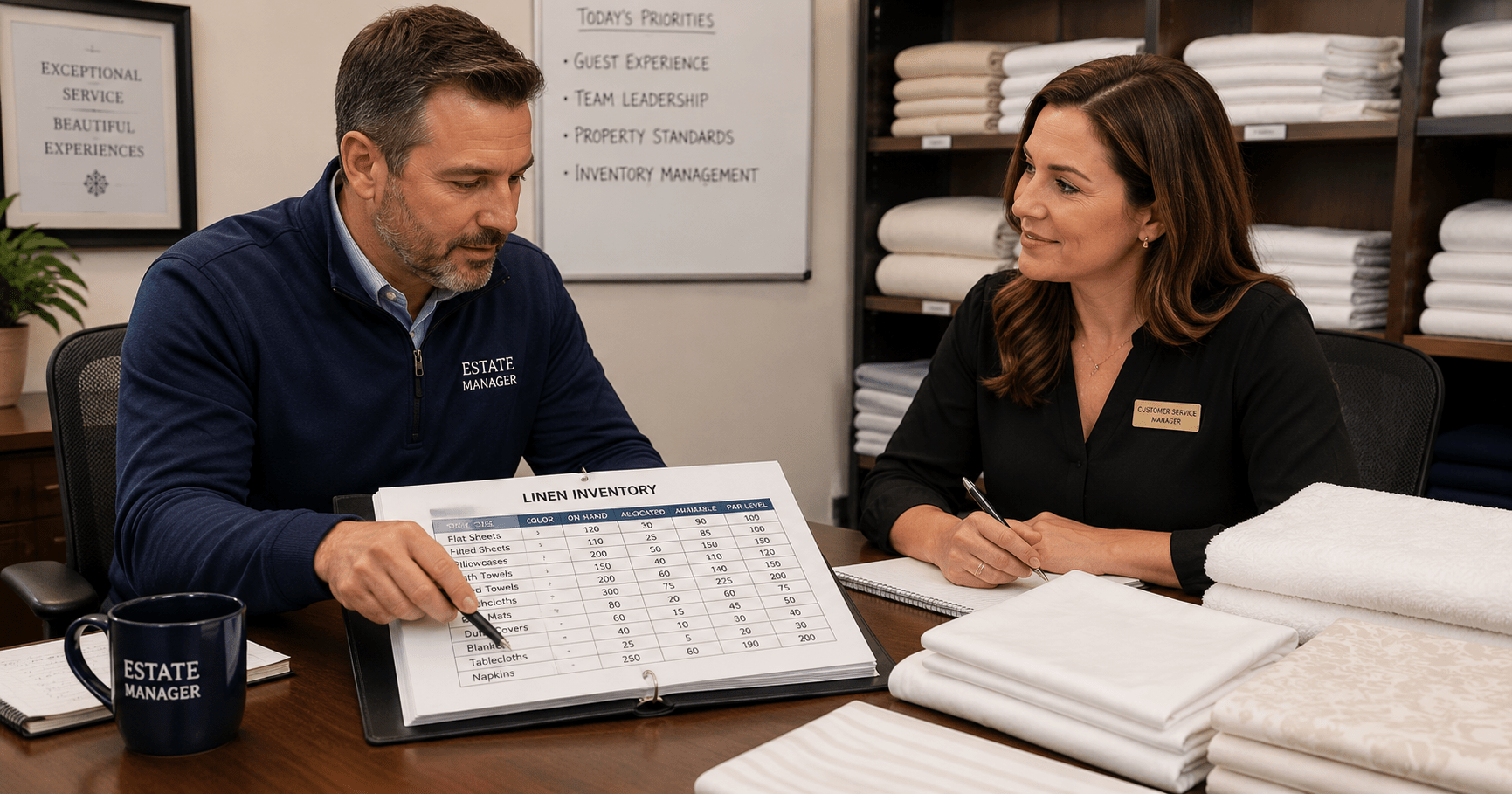
If one breaks down the general responsibilities of an Estate Manager, it often falls into three essential categories: Operations, service, and asset management. While operations and service often receive the most attention due to their visible, day-to-day impact on the household, asset management lives behind-the-scenes, requiring strategic, long-term planning.
Asset management should be approached as any other management system; it follows strategic objectives (such as preservation and readiness), produces deliverables (like inventories, schedules, and reporting,) and plans for the future (such as sales, transfers, and succession). Together, these tools determine allocated resources, facilitate communication with principals, and inform budget development and capital planning.
Managing a Diverse Range of Assets
Estate assets may include real estate, art, vehicles, technology, and personal or collectible belongings, so there isn’t a one-size-fits-all solution. An Estate Manager may need to create systems and protocols that are specific to each asset class. There is a common thread however: documentation.
Every asset requires documentation that establishes identity, confirms ownership, supports valuation, and tracks condition over time. The documents may vary, such as a deed, an appraisal, or a service log, but the function is the same; documentation provides a clear, defensible picture of each asset’s status and value at any given time.
To help keep things organized, an Estate Manager can implement standard, estate-wide systems for the core elements of inventory, tracking, maintenance, periodic review, and reporting. These SOP’s, so to speak, create a pattern for recording and retrieving information that can be replicated and scaled as needed. Then, one needs only to add the unique considerations of an asset to a base portfolio template.
Utilizing Technology
While asset management can be accomplished with spreadsheets and paper records, there are apps and digital platforms that offer enhanced features like inventory management and cataloging, condition tracking, and valuation systems to support more efficient operations. Most are SAAS products that provide secure document storage and automated task scheduling. Most importantly, they offer centralized access for staff, principals, and advisors, making it easier to maintain transparency, improve response times, and support reporting.
Applications to consider range from asset tracking apps to complex holistic management systems. A few we like include:
Asset Panda https://www.assetpanda.com
Asset Panda is a configurable asset tracking and management platform that allows users to build custom fields, track maintenance, upload documents, and assign assets to locations or personnel. While not designed specifically for private estates, it is widely used for physical asset oversight and can be tailored to estate operations.
Artwork Archive https://www.artworkarchive.com
Artwork Archive is an inventory management system built for private collectors, galleries, and institutions. It supports cataloging, provenance tracking, location management, insurance values, and reporting. The platform is well-suited for estates managing fine art, decorative objects, and other collection-based assets.
OENI https://oeni.app/en/
OENI is a digital platform for managing fine wine collections. It offers tools for inventory tracking, valuation, tasting notes, storage logistics, and integration with merchants. The system is designed for private collectors and supports cellar management across multiple locations.
Custodian https://www.custodian.club
Custodian is an inventory and asset management platform created for luxury car collectors. It provides digital catalogs, insurance records, service tracking, and secure sharing features, with a focus on privacy and usability across a wide range of asset types.
EstateSpace https://www.estatespace.com
EstateSpace is a purpose-built estate management platform that supports asset tracking, vendor management, maintenance schedules, project coordination, and secure document storage. Designed for estate teams and family offices, it integrates property, financial, and operational data in one system.
Looking Ahead
Asset management programs should be built to evolve. Estate Managers must consider how their systems will accommodate growth, support value preservation, and align with long-term planning. The strength of these systems lies in their ability to integrate with financial, legal, and administrative functions while supporting estate operations and maintenance.
As technology advances, it continues to simplify how information is shared across teams, allowing for greater accuracy and efficiency in oversight. Asset Management apps are only effective if they serve your unique needs, however. Don’t get caught up with the bells and whistles. The focus should remain on developing a solid framework that is organized, resilient, and ready to support the estate as it moves forward.